


Page 225 - DJML Annual Report 24-25
P. 225
CORPORATE OVERVIEW     STATUTORY REPORTS     FINANCIAL STATEMENTS

                                                                                       March 31, 2025
                                                               (All amount in Rupees lakhs, unless otherwise stated)
               On adoption of Ind AS 109, the Company uses expected credit loss model to assess the impairment loss
               or gain. Based on internal assessment which is driven by the historical experience/ current facts available
               in relation to default and delays in collection thereof, the expected credit loss for trade receivables is not
               significant.

               The  carrying  amo  of  financia  asse  represe  the  max  cred  exposure.  The  Compa  monitor
               credit risk very closely both in domestic and export market. The Management impact analysis shows credit
               risk and impact assessment as low.

           (c)   Liquidity Risk
               Liquidity risk is the risk that the Company will encounter difficulty in meeting the obligations associated with
               its financial liabilities that are settled by delivering cash or another financial asset. The Company’s approach
               to managing liquidity is to ensure, as far as possible, that it will have sufficient liquidity to meet its liabilities

               when they are fallen due, under both normal and stressed conditions, without incurring unacceptable losses
               or risking damage to the Company’s reputation.
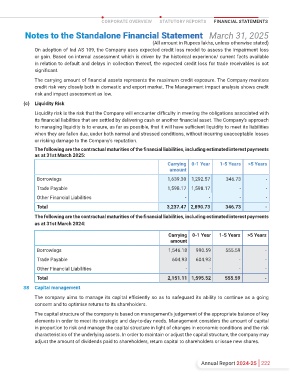
               The following are the contractual maturities of the financial liabilities, including estimated interest payments
               as at 31st March 2025:
                                                                     Carrying  0-1 Year    1-5 Years  >5 Years
                                                                      amount
                Borrowings                                            1,639.30  1,292.57      346.73          -
                Trade Payable                                         1,598.17  1,598.17           -          -
                Other Financial Liabilities                                  -         -           -          -

                Total                                                 3,237.47 2,890.73       346.73          -
               The following are the contractual maturities of the financial liabilities, including estimated interest payments
               as at 31st March 2024:

                                                                      Carrying  0-1 Year   1-5 Years  >5 Years
                                                                       amount
                Borrowings                                             1,546.18    990.59         555.59                 -

                Trade Payable                                          604.93      604.93                 -                  -
                Other Financial Liabilities                                       -                  -                       -                 -
                Total                                                 2,151.11  1,595.52          555.59               -


               The company aims to manage its capital efficiently so as to safeguard its ability to continue as a going
               concern and to optimise returns to its shareholders.
               The capital structure of the company is based on management’s judgement of the appropriate balance of key
               elements in order to meet its strategic and day-to-day needs. Management considers the amount of capital
               in proportion to risk and manage the capital structure in light of changes in economic conditions and the risk
               characteristics of the underlying assets. In order to maintain or adjust the capital structure, the company may
               adjust the amount of dividends paid to shareholders, return capital to shareholders or issue new shares.


                                                                                   Annual Report 2024-25 222

